

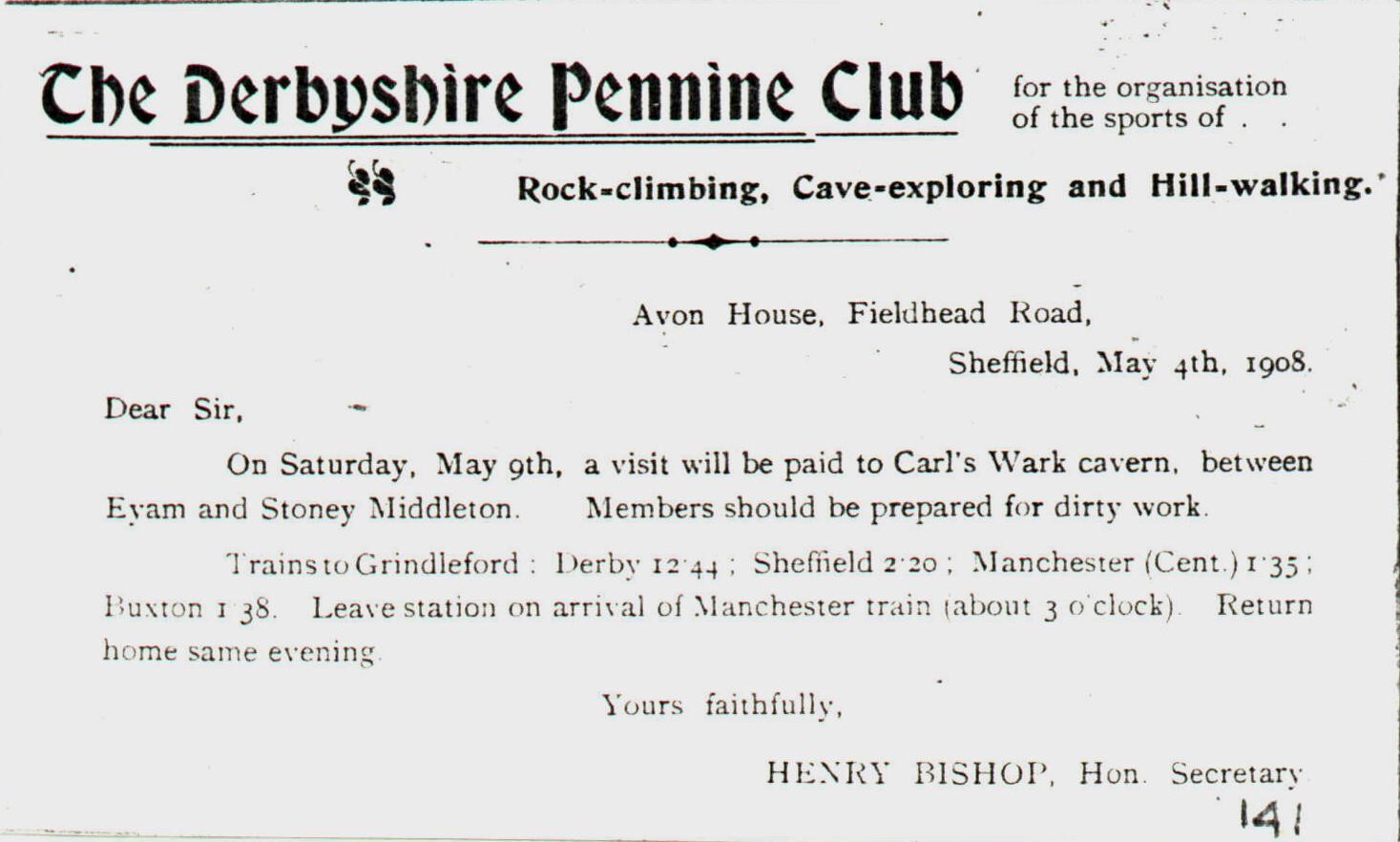
9th May 1908
By H. Bishop
Although Castleton is famed for its caverns, the village has no monopoly of these underground passages and, shortly after the occurrences related above [An Exploration of Peak Cavern Roof], we found ourselves at Stoney Middleton, with Carl’s Wark Cavern (called also the Wonders) as our objective. Any previous remarks as to the conditions, under which the cave man pursues his folly, apply with added force to Carl’s Wark. But ‘the unkindest cut of all,’ is the result of the Stoney Middleton city father’s action in establishing at its entrance – a rubbish tip! The enthusiast, as previously hinted, scorns not water, neither shirks the good, honest cave mud – but a slide down a rubbish heap on one’s stomach! Still, we speedily found ourselves inside.
The uninitiated would probably fail to locate the cavern’s entrance, as it is formed by a slit little more than 12 inches in height and 24 in length, at the very foot of the stupendous limestone crags which line the dale on one side. If we again pay it a visit we shall probably have to dig away through the dumped material. But let us to a lighter subject! Work began almost immediately we had gained the interior. After progressing some feet, it became necessary to wade along a narrow channel whose swollen waters reached almost to our waists. A few minutes saw us at its farther end, and we emerged at a point where, whilst the passage apparently continued forward, an incipient chimney could be seen on our right and somewhere in which was situated the ‘Needle’s Eye,’ as the key to the upper range of passages is termed. The party here divided, one section to prospect the continuation of the lower passage, whilst the other contingent, after the slim man had been to investigate, ascended the chimney and, crawling on a short water worn passage, arrived in a favourable position for reaching the top storey. They were in a narrow, crack-like place, which was climbed until a decent ledge was attained from which the ‘Needle’s Eye’ could be seen forming the narrow commencement of a horizontal passage at the top of the crack. To reach and enter this was the crux of the problem; hand and footholds being almost nil, we were compelled to hold ourselves in place with our back on one wall and knees on the other, working up by sheer strength. The walls were very damp and the difficulty was correspondingly increased. Once past the ‘Eye,’ a crawl amongst detached blocks led us to the upper pipe, which we followed to its extremity. The last 100 feet of this has probably never before been explored, as it is guarded by a roof which approaches to about 9 inches above the floor level. As it was, only the slim member managed to negotiate the place, crawling through on his stomach.
We returned the same way, being much struck by the great number of immense ‘bee-hive’ stalagmitic formations in the passage, and which we thought to be the finest in Derbyshire. The descent from the ‘Needle’s Eye’ was much less difficult than the upward climb had been, as gravitation told in our favour.
The other contingent report having reached a pool of water some 5 feet deep, through which they made their way into a long passage. It will thus be seen that Carl’s Wark cavern provides sport of a high order. We had been at work in it, practically without halting, for nearly 3½ hours!
By F. A. Winder
The writer’s own experiences in these caves have not been cheerful, once especially, the first visit paid to Carlswark in the summer of 1908. There were nine in the party, but after some of the members had negotiated the entrance, the remainder stopped outside. The reason for their desertion was because of the villagers in using the cave as a tip for their ashpit refuse, the mouth of the cavity being filled to a few inches of the top. The local residents must not be solely blamed for the state of affairs. The gypsies camping in the dale have added their little contribution, and casual donors had made gifts of three dead cats, a mangled terrier and a selection of dead fowls!
Certainly, the interior of the cave was cleaner than the porch, but there was an inward draught and the atmosphere could be cut with a knife! The writer had only once experienced such an adventure, and that was when, as a child, he had endeavoured to retrieve a shuttlecock from the depths of the family’s receptacle in his old home.
Another objectionable feature was that, for some unknown reason, the cavern was in flood, the waters of the historic lake reaching nearly to the roof. Puttrell gallantly took the lead, and by creeping round the edge of the pool, managed to reach the further shore and from thence, assured the remainder of the party that he was not even damp. The statement was hard to believe as during his little speech, water was pouring out of a hole in his knee breeches, and the fluid had flowed in through his waistband. Still, it was a ‘white lie,’ told to encourage and for the good of the cause.
Bishop followed with Sprules and the writer in the rear. When traversing round the pool, it was necessary to crawl or rather wriggle along after the manner of an eel. This mode of progression enabled the water to flow down the sleeves and neck band to inner recesses where it remained until the warmth of the body made it no longer cold.
On leaving the pool, we turned to the left up a steep little chimney, and after traversing a short passage encountered the ‘mauvais pas’ of the cave. It consisted of a vertical cleft some twenty feet in height, along one side of which ran a narrow shelf or ledge. This was situated about ten feet from the floor and Sprules made the ascent by the method known as back and foot, that is placing the back against the wall, the feet against the other and wriggling up by a series of muscular contractions. He reached the ledge and sat on it to watch the convulsions of the writer who, in ignorance, started with his feet to the ledge side of the rift. The result of the proceedings was that when he arrived at his goal, he could not alight, as it was impossible to turn without relaxing the pressure on the walls.
Whilst holding himself in position by tightened muscles, he demanded why Sprules had not told him the right way, and Sprules replied after the manner of the Scot! “Mon! Did you ask me?” There was no appropriate answer, so it was necessary to descend to floor level, and like Bruce’s spider ‘try again.’
After a rest on the ledge, there was more trouble in store. The route lay through a hole at the top of the rift, which in its upper portion was wider by the width of the ledge. Back and footwork was impossible and that ten-foot climb absolutely beat us. Finally, Sprules ascended and found a long wooden stemple. This he placed slanting from the ledge to the hole and endeavoured to swarm up it after the manner of the monkey and the stick. He would have succeeded, but unfortunately, the pole broke just as he reached his objective and he slithered downstairs. Fortunately, his feet encountered the ledge and he was pulled to safety.
It was evident that Puttrell and Bishop had, in their usual absent-minded manner, gone on and forgotten all about us. It was a little habit of theirs, forgetting that other members of the party were neither chamois nor monkeys, but just ordinary folk. It is possible that they may read this, but it is one written confirmation of the verbal blessings they have received on more than one occasion.
However, the wait was not of long duration. Sprules descended to the floor and collected a hat full of the same ammunition that David used with success on Goliath. The stones were lobbed through the hole and apparently, the truants had not gone far, for a particular hard pebble scored a bulls eye on the rear part of Bishop’s anatomy, who at once returned to tell us all about it. Then it transpired that they had left all the rope behind, with the exception of a piece of clothesline. This proved inadequate, so those above were left to their own devices. After punishing Bishop by eating a seed cake he had unwisely left in his rucksack, a fresh start was made to explore the mysteries of the lower chambers.
Several caverns in Derbyshire have the reputation for being wet, but for a really soaking experience, the cellars of Carlswark Cavern sump have an easy first. We had already crawled through water, now it was necessary to walk, and at times wallow through it. Progress could not be called wading, for the pools were so deep that the water reached to the shoulders and at times it was necessary to duck to negotiate arches, the crowns of which were only a few inches above the surface.
Holding our candles high, we traversed a long tunnel of which the writer has but a hazy recollection, for the chill was affecting his heart! Then the water became shallow and we crawled through an eyehole, only to again tumble into deep water at the other side. Once the writer’s candle went out, and he made the cheering discovery that his matches were soaked. He endeavoured to obtain a light from Sprules candle, but with no success, for the wick was damp. The case was serious, for if Sprules candle also became extinguished, it meant waiting in the chilly water until the arrival of a search party. Finally, a new wick was exposed by the simple method of biting off the candle end, and after an anxious moment, it took fire.
The form of the cavern had changed to a chamber of fair size, and careful progress enabled the writer to make his way partly round the circumference. Then he received the worst shock of his caving experience, for he saw a white and clammy object floating on the surface, which he took to be the naked body of a man. It appeared to be floating face downwards and showed like a huge dead fish. In his terror, the writer again managed to extinguish his light, and he yelled like a frightened child for Sprules to come to him!
The Scot, who was examining a possible exit, ‘kept his head.’’ “I’m coming, laddie,” he said quietly. “Keep still until I cross the water.” When he arrived, the writer again repeated history by biting off another bit of candle, and cautiously again ‘borrowed a light’ from Sprules.
By the double flame, the object was examined across the surface of the pool. Sprules drew a quick breath and muttered “the poor, poor wee body.” Then cautiously advancing, he gave the gruesome thing a poke with his stick. It rolled over like a porpoise and four legs showed pointing stiffly to the roof. There was a sickening gurgle as the air in its distended body escaped. Then it sank, a trail of bubbles rising to the surface.
The writer commenced to laugh, and could not stop. It was the nearest approach to hysteria he had ever known. Sprules slapped him roughly on the shoulder, and shouted angrily, “Don’t be a bloody fool! Cannot you see that its only a poor wee dog, with its hair rotted off its jacket.” As the animal was nearly the size of a donkey, the term ‘wee’ was hardly appropriate, and caused fresh merriment this time of a genuine character. It enabled the writer to pull himself together, and another search was made for an exit from the chamber.
More passages were traversed which appeared to lead in a new direction than those already examined, and they in turn, took a different twist every few yards. Then we squeezed through another eyehole, and took stock of our surroundings. These appeared strangely familiar and it was discovered that we were nearly back at our starting point. This was annoying, but had its bright side, for we were able to draw the last two candles from a reserve cache in a cleft of rock.
Then we set off again, through the water in an endeavour to find a feasible route, but the candles were locally purchased ‘dips,’ and burned quickly. It was a question whether they would last to the surface. Therefore we made for the daylight, and an even more direct route to the Bull’s Head and hot whisky in large sized mugs.
Puttrell and Bishop returned later, asserting that they had been searching for us. Both were dead tired and soaked to the skin. They looked with longing at the second addition of whisky punch, but held fast to their principles regarding abstinence.
The upper passages were described later by Sissons, who had arrived late with Amies. They had found Bishop’s rucksack, eaten the remainder of the cake and then followed the clue. After climbing through the eyehole, which Sissons long legs enabled him to reach, they scrambled up some loose rocks and entered a roomy passage with a scree floor. Although the passage was fairly high, the roof lowered in places, making progress somewhat difficult. On the floor were some rather fine examples of beehive stalagmitic formation, but the water appeared to have altered its course since their formation, and they had in consequence, become dead masses of stalagmite.
The general trend of the passages was towards Eyam, and there appeared to be some foundation for the belief that at some period, communication had existed between the village and the dale. The grotto, said to exist near Foolow, has not yet been located, or so the writer believes.
F.A.Winder.
(Footnote for the above report: F.A.Sprules was a member of the DPC from its formation in 1906. Evidently, he was a keen climber. Unfortunately, just a few months after the Carlswark meet, he was killed, with his brother, on Pillar Rock in the Lake District on Tuesday 13th October 1908. It was assumed they had strayed into Savage Slit from the North Climb, – DPC Librarian 1997).
 Derbyshire Pennine Club