
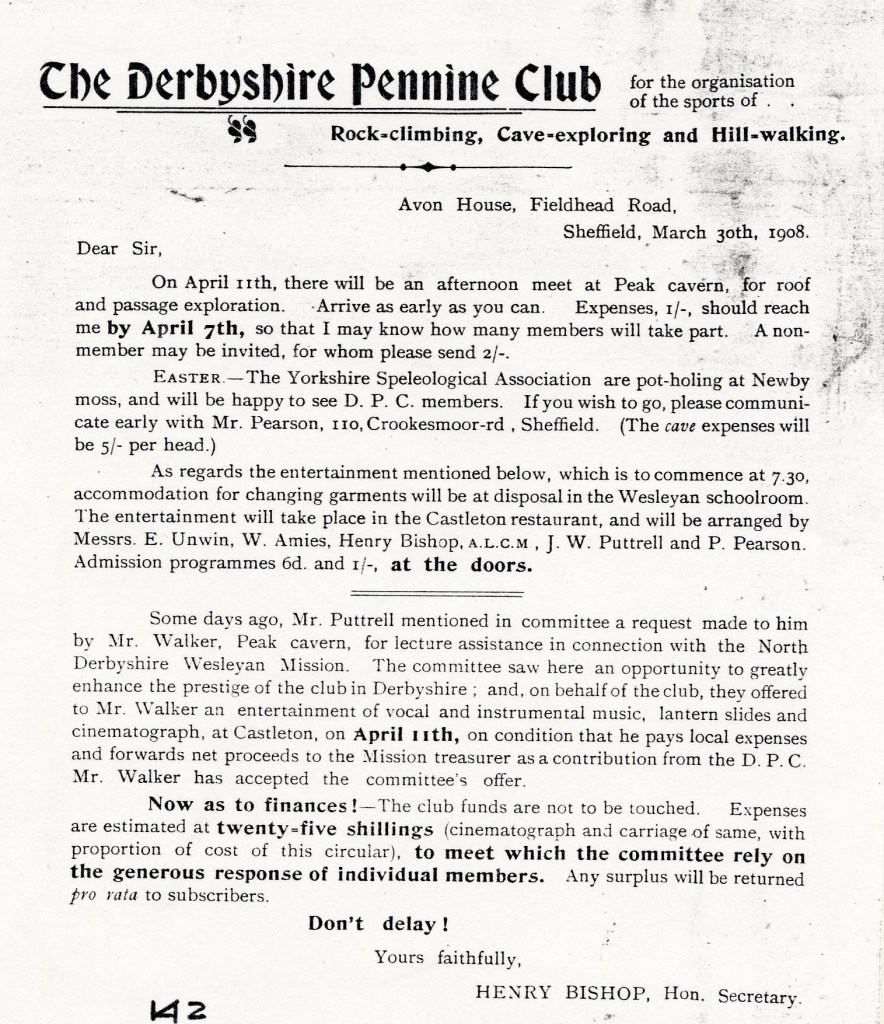
11th April 1908
April 11th was a very busy day for the Club, for not only were explorations conducted in the Peak Cavern, but also an entertainment was given in Castleton, of which particulars follow. In recognition of many pleasant visits to the caverns, etc., of the village, the Club’s members, by means of voluntary subscriptions, defrayed the expenses of the entertainment.
Cavern exploration and entertainment giving are two occupations having nothing in common, but an event which took place in Castleton on Saturday evening last leaves no room for doubt that the members of the Derbyshire Pennine Club, at any rate, are quite equal to the double role. The event was a musical, lantern, and cinematograph entertainment given by the club, the net proceeds of which are being presented to the North Derbyshire Wesleyan Mission.
The members of the club emerged from the recesses of the Peak Cavern, and adjourned to the Castleton restaurant, where the interest of a large audience was sustained for two hours by the efforts of Messrs. Edwin B.Unwin, J.W.Puttrell (President), Henry Bishop A.L.C.M. (Hon. Secretary), W. Elliott Amies, and P. Pearson.
Mr. W. Young, of Hope, presided, and Mr. Unwin’s songs were ‘The Deathless Army’ (Trotere) and ‘The Longshoreman’ (Gresham). Mr. Amies contributed ‘Like Stars Above’ (Squire), and ‘Roses’ (S.Adams), whilst Mr. Bishop, who also fulfilled the duties of accompanist, rendered Nollet’s ‘TarantelIe’ on the pianoforte. Messrs. Amies and Unwin also gave Benedict’s duet, ‘The Moon Hath Raised Her Lamp.’
A short illustrated chat on Switzerland by Mr. Puttrell, and an exhibition of humorous and other films on the cinematograph by Mr. Pearson, completed the programme.
In amplification of the above report, it may interest readers to know that (1) the Club changed its clothes before going to the concert; (2) £5-3s was realised and presented to the Fund; (3) at the conclusion of the concert, members returned to the cavern for another spell of work.
When a certain famous writer discoursed so eloquently on the joys of communion with Nature, the subtle influence of moorland, mountain and stream, it is scarcely to be wondered at that he did not go farther and include some reference to the subtle thrill of the underground world as it is known to the speleologist. The pedestrian takes his pleasure under the stimulus of a bountiful supply of light and air, whilst he who would explore caverns must follow his sport where the atmosphere is often deficient in oxygen, and where the sun’s rays never penetrate. The mountaineer and the cragsman can also count on enjoying abundance of light and air; but the thoroughgoing cavesman must be prepared to climb under conditions, which his outdoor brother would declare execrable. Difficult rockwork demands, under the best conditions, all the attention and skill of the climber. In a cavern, however, it is often done to the unsavoury accompaniment of slime and mud and by the light of a tallow dip, which must be carried in the hand, and which serves but to render darkness visible. Water is encountered, through which it may be necessary to wade waist deep; passages must be crawled along, so small that the explorer cannot raise his head for fear of encountering the roof. And yet, with all its disadvantages, your ardent cave man will tell you that his sport can compare with any in the world for excitement, interest, and profit.
The Derbyshire or Sheffield speleologist’s Mecca is Castleton. Thither journeyed recently a strong party of members of the Derbyshire Pennine Club, the object of whose visit was to investigate a remarkable passage or chimney, which, starting from Cave Dale, leads almost vertically downwards for over 100 feet, ending in the recesses of Peak Cavern, near the platform known as the Orchestra. As it had never been climbed, two members entered the cavern about an hour before the nominal time for commencing the investigations, in order to see whether the place might be ascended by ordinary crag climbing methods. They roped up, and after considerable trouble with the candles, due to the water which came down the chimney, reached a height of 60 feet by climbing the jammed stones which occupy one corner of the aperture. But here progress was most effectually barred by the total lack of hand and footholds, whilst, for many feet above, the water-streaming walls widened out so that it was impossible to wedge between them by friction. Therefore they had to descend, and that quickly, as any stones dislodged by the men now due in Cave Dale might have meant broken craniums.
During some excavations in another passage of the cavern, we had noticed a decided air current, and had, by burning sundry smoke producing materials, succeeded in showing the existence of a connection with the above mentioned chimney by noticing that the fumes of our fire came out at its upper exit.
Dislodging the dangerous fragments of stone, the slimmest member of the party now tied himself on to the extremity of a length of Alpine rope, and was cautiously lowered down the chimney, which, he opined in his downward passage, would be climbable but for the wide middle section described above. But our object was to investigate any channels which might lead to the point at which our fire had been lit; and, as this could not be satisfactorily done whilst suspended by a rope round one’s chest, an attempt was now made to draw up our rope ladder, which had been carried to the chimney’s foot. This proved abortive, owing to the rings catching on a projecting nose of rock; so the ladder was carried round to the upper exit, and it was from thence lowered in twenty minutes. Secured by a lifeline, another member now descended, and, resting on the ladder was able to make an exhaustive inspection of the streaming walls, the candles that he planted at intervals disclosing to those below a magnificent spectacle. The only aperture he could discover, however, was one on the level to which the first mentioned pair had climbed. A short wooden ladder was now hoisted to this point, and, being held horizontally enabled two climbers to reach the aperture. It was found to lead nowhither in particular, and was formed by a jammed mass of stones, with a space between it and the roof. We came to the conclusion that our smoke had somehow worked back into the main cavern, and then, impelled by a current of air, had passed behind and over the jammed mass and thence up the chimney to its exit in Cave Dale.
Henry Bishop
 Derbyshire Pennine Club