

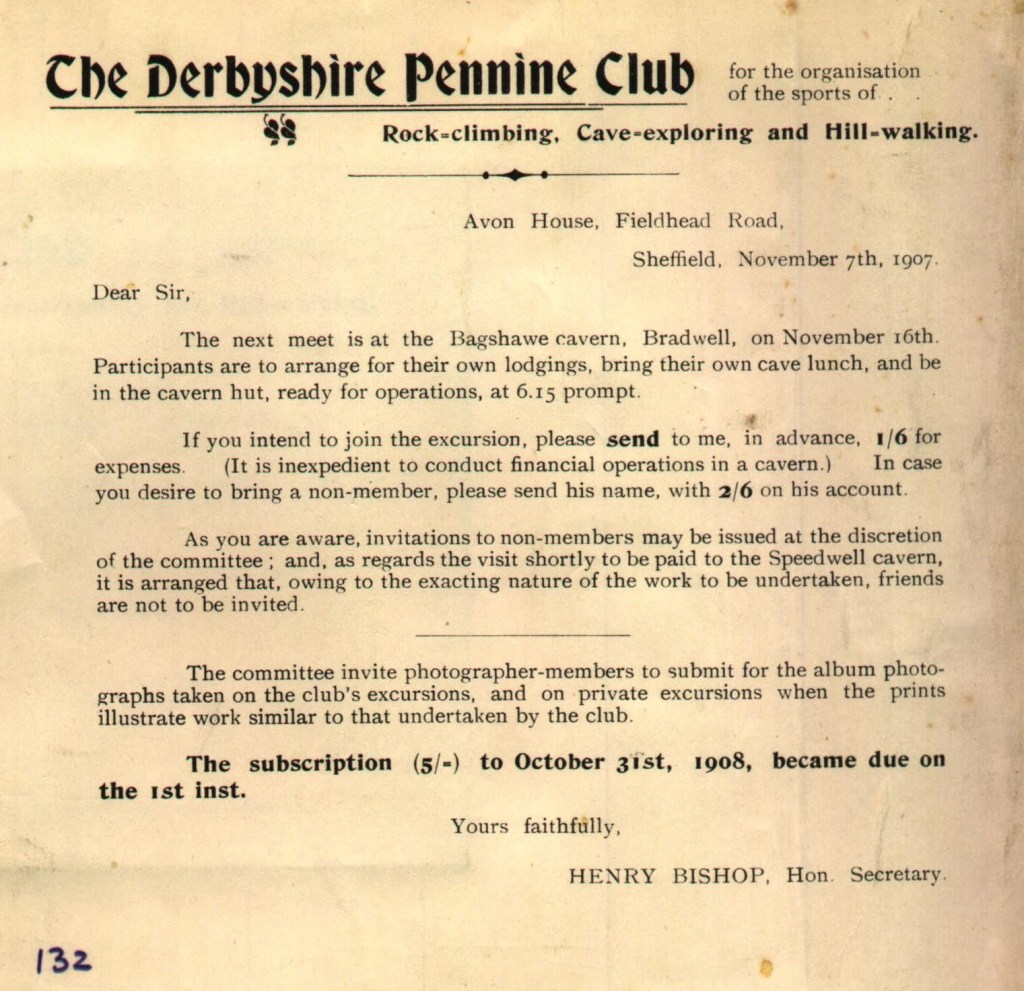
16th November 1907
By H. Bishop
On November 16th, 1907, thirteen members and friends spent a most enjoyable evening in the Bagshawe Cavern, Bradwell. Some surveying was done on the upper level, and later, a most fascinating and but rarely visited fissure below the Dungeon was examined. This is known as the Birdcage, or Bird Cave, and is chock full of beautiful calcine formations. During the evening, rain fell very heavily over Bradwell, and was responsible for the hurried retreat of three bold men who had penetrated some 150 feet into a water passage, or syphon, at the end of the upper level. In a very short time the water market rose rapidly, in sympathy with the reports of heavy rain crops – to borrow Stock Exchange phraseology – and our friends saw that their avenue of retreat might be turned into a prison unless they bestirred themselves.
The following article was produced for F. A. Winder’s guide ‘The Caverns of Castleton,’ and is much of the chapter devoted to Bagshawe Cavern. The book was published in 1938, and indeed the article begins with the said meet but then tends to digress into the 1930s. (DPC Librarian 2001):
By F. A. Winder
The writer’s first inspection of the Bagshawe Cavern took place in the autumn of 1907, when he formed a member of a party comprising officials and friends of the Derbyshire Pennine Club. His duty on that occasion was to make the survey on which the plan accompanying this chapter is based.
Prior to commencing work, Mr. Revill, the lessee, kindly pointed out to him the most entranc¬ing places in his domain. It is necessary to resort to poetical language when referring to that inspection, for many of the names savoured of the classics.
At a little distance from the foot of the staircase he obtained his first view of the Grotto of Paradise, which he discovered to be in close proximity to the Giant’s Foot. Soon afterwards he ascertained that the Crystallised Cavern was a rival in interest to the Elephant’s Throat.
A passage inclining to the right formed the approach to Calypso’s Cave, which in turn served as an ante-room to the Straits of Dover.
It was difficult to separate the appropriate from the mythological in the choice of names. What possible relation could exist between the celestial regions and an elephant’s gullet, and why should the Fairy Palace of Calypso be passed en route for the prosaic Straits of Dover?
Although the writer has treated the different features lightly, it must not be thought that the cavern is lacking in beauty or attraction. It is a strange characteristic of the place that, although its length is greater than that of any other known cavern in Derbyshire, its attractions take the form of miniatures like Turner paintings on a large wall.
The larger chambers, though small in comparison with others, contain some most beautiful formation and chinks in the rock coated with stalagmite remind a visitor of greater chambers reduced to a tiny scale.
The chamber known as the Dungeon, situated at the end of the ordinary route, is perhaps the most interesting feature in the cave. The name is apt, for it is approached down a flight of worn stone stairs, and the whole environment is reminiscent of a scene in the narrative written by the late Edgar Allan Poe, and entitled, “The Pit and the Pendulum.”
To add to the weirdness of the place, there is a gaping hole in the floor from which comes the faint sound of dripping water. In reality the pit is of no great depth, but visitors are advised to respect it, for a slip would entail a fall of some twenty feet.
From the Dungeon there are two alternate routes open to an explorer. He can proceed along the natural passages at his present level and later encounter tribulation, or he can descend the pit and at once find trouble by slipping under a low arch into a pool of icy water. The depth varies, accord¬ing to the season, and in dry weather he will only get wet to the thighs.
On the occasion now being referred to, the upper passages were selected for survey purposes, and even these provided all the variety the most exacting cave-explorer could desire.
The caution of one member of the party also proved to be a difficulty. He had on one occasion been lost in a cavern, and therefore came provided with a huge drum of cord, which he unrolled to leave a backward trail. The procedure of necessity caused delay, until a strong-minded companion dealt with the situation by severing the twine; and, as the owner would not proceed without its moral support, he was left searching frantically for the lost end.
Thenceforward work proceeded more rapidly until water was encountered in unexpected quantities, although it might have been anticipated, as the chamber through which it flowed was known as Blackpool Sands.
The cavity is of fair dimensions, with a low roof and a sloping, sandy floor. There is a hole in the rock at the higher level, which denotes the entrance to a waterworn tunnel leading to a feature sarcastically termed “ the Glory Hole.” This, in the opinion of the writer, is one of the most loathsome spots he has ever encountered in a Derbyshire cave. It is rather similar to the Rabbit Hole in the Blue John Cavern, but the nice dry vertical drop in the Burrow is represented by a hole in the floor of a very different character. The hole may be compared to a gigantic candle snuffer or cone some thirty feet in depth, at the bottom of which is a pool of putrid water. Several inquisitive people have descended to the water level on a rope, and at one period Sissons, Amies and the late Captain Smith made it a weekend ritual. Other explorers have given their opinion regarding the place after an odd visit, but their remarks cannot be repeated.
The main chain of caverns extends for a considerable distance beyond the sands. They may be described as a series of low chambers, passages and vertical rifts. In places the water reaches nearly to the roof, and its level is little affected by dry weather.
Progress is finally arrested by an underground stream, which flows approximately at right angles to the main passage. It may, therefore, be assumed that, unless geological changes occur, the use of explosives will be necessary to force a passage, as the water reaches to the roof of the channel. Messrs. Grainger, Chantry and other enthusiasts are still concentrating on the problem, and have in fact discovered other passages, which may enable the syphon to be passed.
A systematic examination of the lower passages has proceeded at intervals for a considerable number of years, but they cannot be regarded as a desirable playground for novices at the game. The chambers contain some most beautiful stalagmitic formation, a photograph of which illustrates this chapter.
One of the most beautiful features is a subsidiary cavern in the roof known as the “Bird Cave”; but those who desire to inspect it must be prepared to emulate our early ancestors the monkeys.
Beyond this point are other chambers and passages of varied character. Some are flat and wide, others high and narrow. Water is always present, and in dry weather bad air may be encountered.
The chain culminates in an inclined circular tunnel leading down to a saucer-shaped pool.
On the last occasion when the writer explored the cave, the saucer was found to be dry, and progress was made beyond it for another twenty yards before the roof met the floor.
Incidentally, the members of the party were nearly asphyxiated by carbonic acid gas, which also extinguished the candles; and, but for the foresight of Mr. Charles Baines in having provided himself with an electric torch, the sequel might have provided an illustration of the risk ever present during cavern investigation.
The writer would like to add a platitude regarding the unsuitability of the place for ladies, but unfortunately his hands are tied. On one unhappy occasion, when acting as an assistant guide to a party which included members of the “weaker” sex, he contracted a severe internal pain, and had to be assisted for the last twenty yards to the Dungeon by the fair damsel who was nominally in his charge. It was a humiliating experience, and he had to bribe her with a stalactite and a piece of Blue John to refrain from broadcasting the incident, which, to others, certainly possessed a humorous side.
Incidentally a warning should be given against entering the remoter portions of the cavern unless accompanied by Mr. Revill or some authorised person conversant with the ground. Trespass is always an undesirable proceeding, and if committed in the Bagshawe Cavern may result in the organisation of a rescue party.
 Derbyshire Pennine Club