

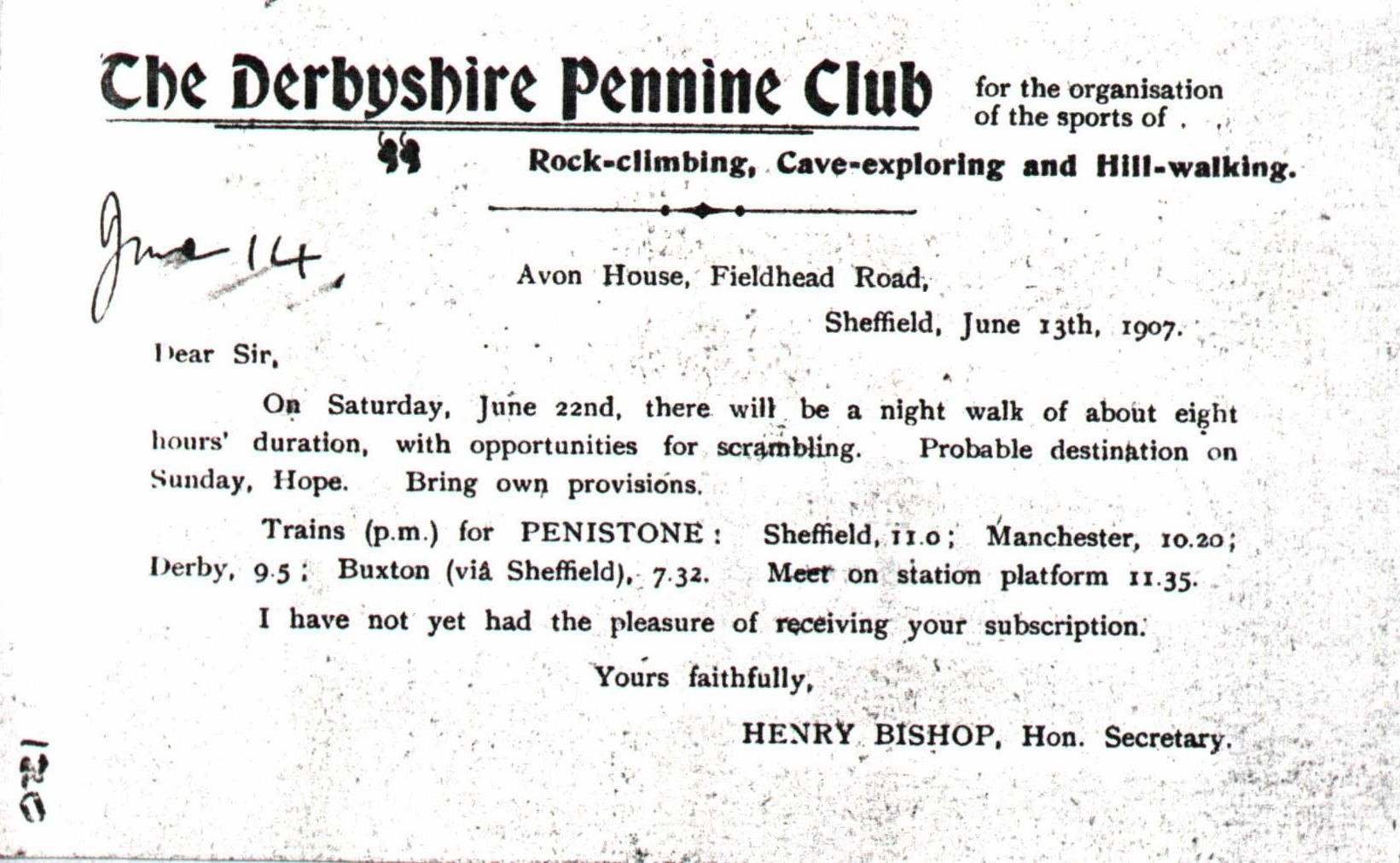
22nd – 23rd June 1907
It was only a stern sense of duty that impelled us to turn up at Sheffield Station, in pouring rain, an hour before midnight. This year has been remarkable for its weather, and the night in question was one of the worst; so, when we requested to be supplied with Penistone to Bamford walking tickets, there certainly seemed some ground for the astonished booking clerk’s assertion that we should all be drowned.
The occasion was a moorland walk from Penistone to Bamford via Cutgate and Slippery Stones, organised by the Derbyshire Pennine Club. This walk is, of course, nothing new; the novelty was to consist in doing it at a time when all good people were in bed. Acting on advices from Old Moore, the Club Committee had wisely arranged for the moon to shine for an hour or so; but our faith in the Almanack was considerably shaken when the Queen of Night failed to put in an appearance during the earlier part of the railway journey. The Committee’s arrangements were vindicated, however, when, about a mile before Penistone was reached, the thick storm clouds parted, the rain teased, and every tree and hedge showed out distinctly in the moonlight. Two Manchester members awaited us at Penistone, and we set off in high feather at about a quarter to twelve. During the first half an hour the weather was on its best behaviour, a piercing wind being accounted as nothing. Then up rolled ominous clouds, and we were treated to some stinging rain, which continued, with a slight interval, until the new reservoir was reached, and the farm of North America hove in sight. About this time faint streaks of dawn were visible on the horizon at our rear.
Near the farm the way turns off at right angles; and, having succeeded in waking no dogs, we forsook cart track for moorland path, and comparative quiet for rainstorm and howling wind, which were to continue for some hours. The path was not always plain in the half-light, and now and again we progressed more by faith than by understanding.
Rising gradually, the path attains a height of about 1300 feet, and then turns somewhat to the left as a slight descent is reached. The full force of the gale was now apparent, sometimes hurling us from the narrow track and almost flooring us, the driving rain meanwhile searching our garments. It was pleasant to encounter, in about an hour, a little wooden hut by the side of the path. If only they have left open the door! They had; and, in almost less time than it takes to tell, we were inside, unpacking our lunch. One man went outside to look for water, but the pouring rain had rendered all the streams unfit for drinking. So recourse was had to ginger wine, and, in some cases, to a wee flask of something stronger. The light was very uncertain, and the rain worse than ever when we shortly afterwards forsook our hut.
The highest point of the Cutgate was attained after about a mile of walking, or, rather wading, along the sunk track, and at about 1650 feet above sea level we began to look out for sunrise. But sunrise this morning was a ghastly affair; nothing else could be expected considering the sloppy sky. The only redeeming feature was a fine streak of steely dawn blue away to the left, over Margery Nield. All the front distance was blotted out by fog. We could, however, see the valley through which we were to pass to reach Slippery Stones. The descent is in places rapid, and the deluge had converted every streamlet into a respectable brook, whose contents found a facile passage through puttees and into boots.
A wee rabbit which we encountered shortly afterwards (it was wet to the skin, says our humorist) seemed in no hurry to depart, but rather appeared to court our companionship. It was almost the only living thing we had seen on our walk.
Arrived at the ford, Slippery Stones were not to be seen for the rush of water along the infant Derwent’s course. So, reflecting that, had we attempted to cross, the booking clerks prophecy of death by drowning would probably have been realised, we kept to our side of the river, along the path leading to Howden House. The weather conditions had slightly improved by the time this was reached, and the view began to open so that we were shortly enabled to make out some of the curious rock formations on Derwent Edge.
The Birchinlee reservoirs, yet in the making, loomed large and ghostly as we passed above them shortly afterwards. The party became divided, one contingent crossing to the right to inspect the navvies village, whilst the other kept straight on towards Derwent Hall, halting on the way under a convenient wall, where water was poured from boots in the intervals of a second lunch.
Gleams of sunshine enlivened the journey to Bamford, alternating, however, with showers – hints of what might happen to us should we become too jubilant. The people at the inn near the station, where we called for breakfast at about 8.15, were obviously in doubt as to our character – were we tramps or madmen? The state of our garments certainly favoured the former hypothesis. So they kept us in the bar until breakfast was ready!
H. Bishop
 Derbyshire Pennine Club